

Early Research Impacts: Catching Up with the Inaugural Collaboration in Action Teams
December 10, 2025
Through an inaugural round of funding in 2024-2025, seven collaborative research teams received $1.6 million in support and sprang into action in January. This is where they are now.
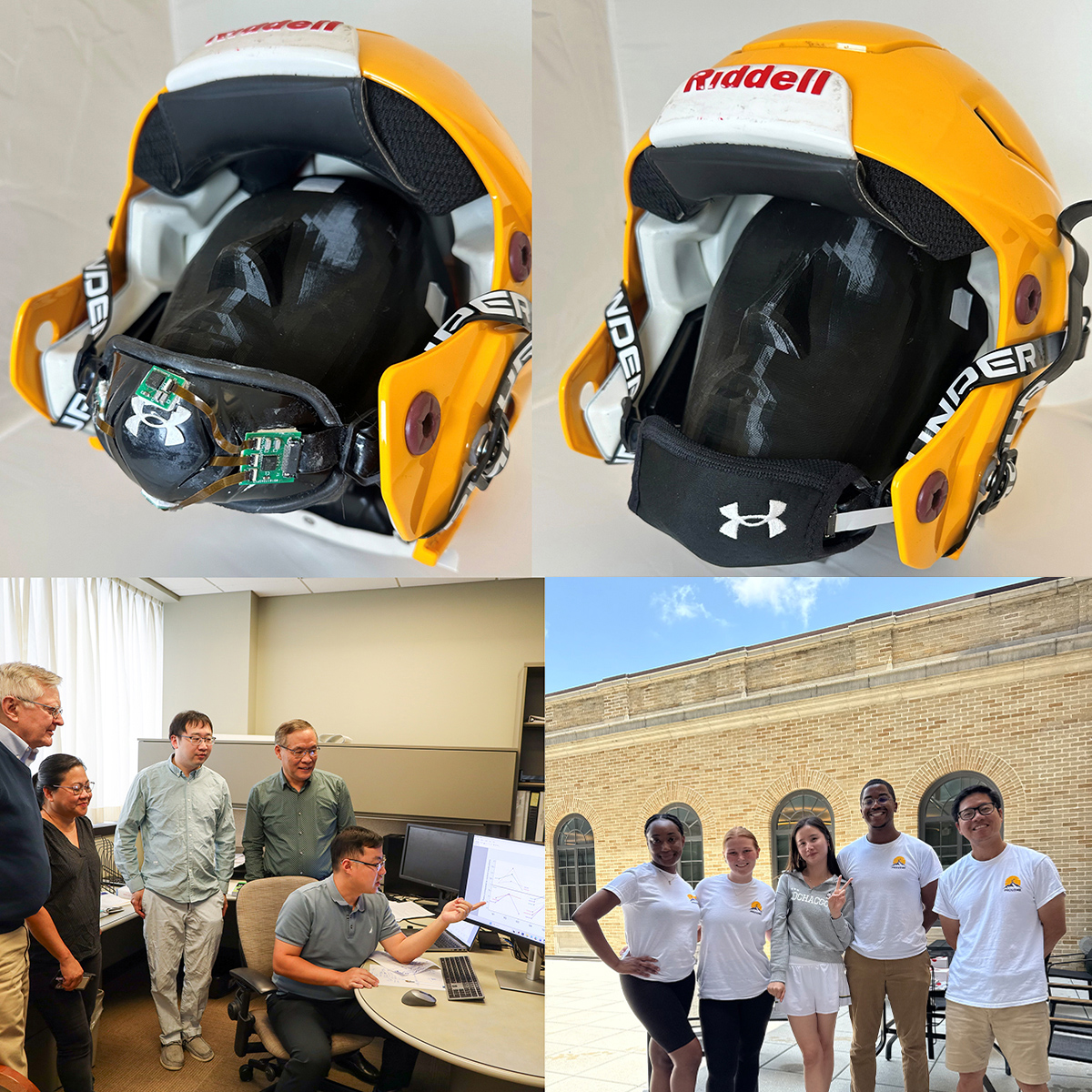
Genevieve Palardy’s team has designed, manufactured, and validated new sensor systems, including custom-printed circuit boards cast in silicone, for football players’ helmets and chinstraps to protect brain health (top). Dr. Yun Shen's team is using AI to explore electronic health records from Our Lady of the Lake Health to prevent Type 2 diabetes patients from also suffering from cardiovascular challenges (bottom left). Senlin Chen, at right, with ProudMe camp counselors (bottom right).
In 2022, FMOL Health Our Lady of the Lake, LSU’s Championship Health Partner, made a landmark investment in LSU—$170 million. That investment launched the Collaboration in Action research program to solve health challenges in critical areas for people in Louisiana, including cardiovascular disease, cancer care, trauma and neuroscience, chronic respiratory disease, medical data science, and sports medicine and performance.
Advancing long-term athlete health and well-being through translational research
Goal: Collect cardiometabolic, immune, and behavioral pilot data from previously competitive LSU athletes to go after funding for a bigger, longer study to understand athletes’ health throughout their lifespan and better prepare current athletes for life after competition.
Wins: The team has collected plasma, serum, and saliva samples from 290 current LSU athletes to build a biobank of samples to study their long-term changes in health. The researchers have also completed physiological testing of former LSU athletes between 25 and 78 years old.
What’s next? Continue to collect samples and data while applying for large, federal research grants.
On the team: Neil Johannsen (LSU Kinesiology, Pennington Biomedical), Shelly Mullenix (LSU Athletics), Dr. Hollis O’Neal (LSU Health New Orleans, Our Lady of the Lake), Guillaume Spielmann (LSU Kinesiology, Pennington Biomedical, Our Lady of the Lake), Tiffany Stewart (Pennington Biomedical), Samuel Stroope (LSU Sociology), Dr. Robert Zura (LSU Health New Orleans, Our Lady of the Lake).
Harnessing AI for precision hypertension management—advancing treatment paradigms in Type 2 diabetes care
Goal: Reduce the risk for people living with Type 2 diabetes to also suffer from cardiovascular challenges as most of them (85%) have high blood pressure. Improve personalized treatment and control of high blood pressure through AI analysis of Our Lady of the Lake electronic health records for Type 2 diabetes patients.
Wins: The team has completed data extraction at Our Lady of the Lake and defined the necessary data to build an AI-based decision-making system at Pennington Biomedical Research Center, including medical codes, medications, clinical test and lab results, and demographic data.
What’s next? Analyze the securely transferred Our Lady of the Lake electronic health record data and develop an AI-based decision-making system on type and dosage adjustment of anti-hypertensive medications among Type 2 diabetes patients.
On the team: Dr. Yun Shen (Pennington Biomedical), Shuangqing Wei (LSU Electrical & Computer Engineering), Dr. Ibrahim Musa Yola (LSU Health New Orleans), Dr. Tiffany Wesley Ardoin, Dr. Tonya Jagneaux, and Dr. Jolene Johnson (LSU Health New Orleans and Our Lady of the Lake), and Dr. Gang Hu, Ronald Horswell, and San Chu (Pennington Biomedical).
Leveraging electronic health records and advanced image processing to identify and address disparities in the diagnosis and treatment of valvular heart disease
Goal: Catch and treat heart valve disease before it causes bigger problems. Develop an AI tool to screen existing clinical images of the heart as well as electronic health records from Our Lady of the Lake to provide personalized guidance on who might be at risk and possible next steps. Identify undiagnosed and misdiagnosed cases.
Wins: The LSU researchers were successfully onboarded as research volunteers at Our Lady of the Lake to gain access to clinical images and electronic health records. The team compiled over 200 diagnostic and procedural codes for patient selection, over a dozen echocardiography-based measurements per patient, and a multitude of relevant data points from electronic health records to prepare their analysis.
What’s next? Finish compilation of longitudinal patient-specific data from electronic health records for statistical analysis and predictive modeling. Identify and model disparities in long-term clinical outcomes based on patient, disease, and treatment characteristics. Complement the study by mining the National Readmissions Database, which includes information on 60% of all U.S. hospital discharges, to discover connections between patients’ socioeconomic status, other demographics, and the probability of hospital readmission after treatment for heart valve disease.
On the team: Bruno Rego (LSU Biological & Agricultural Engineering) and Dr. Jorge Castellanos (Our Lady of the Lake).
Leveraging social behavior factors of pregnant women in Louisiana and in vivo models to study the impact of maternal vaping on birth outcomes and asthma in offspring
Goal: Identify the relationship between pregnancy intent, maternal vaping, and birth outcomes, including in an in vivo model to assess prenatally exposed offspring’s risk of developing chronic lung disease and asthma. Develop preventive and interventional strategies.
Wins: The team discovered that different sociodemographic characteristics, stress, and health conditions shape the use of cigarettes versus e-cigarettes before and during pregnancy. They also highlight the importance of complete cessation for improving birth outcomes and suggest e-cigarette use may follow different behavioral and social patterns than traditional smoking. Cigarette use during pregnancy was associated with lower socio-economic status, whereas e-cigarette use was not. While in an experimental model, prenatal exposure to e-cigarettes also reduced birth weight and decreased lung function. Overall, this study emphasizes the need for tailored public-health messaging that both promotes cessation and addresses the emerging dynamics of e-cigarette use during pregnancy.
What’s next? Continue to analyze the in vivo experiments to look at dust-mite-induced asthma and how it impacts the lungs of offspring exposed prenatally to e-cigarettes.
On the team: Alexandra Noël (LSU Veterinary Medicine) and Heather Rackin (LSU Sociology).
Personalized mTBI digital twins for American football athletes
Goal: Develop personalized digital twins of athletes to enhance the understanding and assessment of mild traumatic brain injury (mTBI) in high school football athletes. Establish a protocol and evaluate feasibility for in-game impact sensing and post-game data collection, including electroencephalogram (EEG) and rheoencephalogram (REG) measurements to assess brain health.
Wins: The team has designed, manufactured, and validated sensor systems, including custom-printed circuit boards cast in silicone, with optional placement in players’ helmets, chinstraps, and handwarmers. A 3D brain model was also successfully developed to simulate brain deformation under repeated impacts.
What’s next? Work with two Baton Rouge-area high school football teams—Catholic High School and St. Michael High School—on potential implementation.
On the team: Genevieve Palardy, Hunter Gilbert, Robert Herbert, and Andrew Becnel (LSU Mechanical and Industrial Engineering), Kshitiz Upadhyay (Aerospace Engineering & Mechanics at the University of Minnesota Twin Cities), and Dr. Shannon Alwood, Greggory Davis, Dr. Richard Lewis, and Dr. Michael Truax Jr. (LSU Health New Orleans, Our Lady of the Lake).
Preventing childhood obesity through AI-assisted behavioral counseling
Goal: Combat childhood obesity, as the state of Louisiana has one of the highest obesity rates in the nation with 40% among adults and 22% among children. Use geographic information systems, or GIS, to map disparities in childhood obesity risk across Louisiana communities. Conduct a clinical trial with Louisiana adolescents to test the effect of the LSU-built ProudMe program (Preventing Obesity Using Digital-assisted Movement and Eating) over a summer.
Wins: The team has completed its mapping of childhood obesity and obesity risk in Louisiana and found significant disparities related to walkability, park access, and food environments across Louisiana communities. The researchers have successfully developed the ProudMe app to enable AI-assisted health behavior management for adolescents. They conducted a pilot trial of the ProudMe summer intervention in 2025 (it was a two-week, half-day summer camp followed by digital self-monitoring and engagement with parents over five weeks). The camp made a clear impact on participants’ weight (i.e. waist circumference).
What’s next? Recruit a larger sample with random group assignments in summer 2026. Improve the ProudMe app user experience. Focus on removing barriers to post-camp lifestyle changes. Make campers’ summer days more structured. Leverage the research findings to compete for larger NIH grant funding.
On the team: Senlin Chen (LSU Kinesiology), Amanda Staiano (Pennington Biomedical), Fahui Wang (LSU Geography and Anthropology), David Shepherd (LSU Computer Science & Engineering), Dr. Stewart Gordon (Louisiana Healthcare Connections), Dr. Katie Queen (Our Lady of the Lake Children’s Health).
Real-time intraoperative mapping of tumor margins during resection of pancreatic adenocarcinoma using AI-enabled Raman spectroscopy
Goal: Develop an AI-assisted device and imaging technology that can tell the difference between healthy tissue and cancerous tissue during cancer surgery. Ensure clear margins and prevent cancerous tissue from being left behind. Lower the current cancer recurrence rate of 40% within five years.
Wins: The team’s pilot clinical study showed 96% accuracy in identifying cancerous from non-cancerous tissue.
What’s next? The team will collect more clinical data from patients at Our Lady of the Lake to build an even more robust AI model.
On the team: Jian Zhang (LSU Computer Science and Engineering), Dr. Michael Dunham (LSU Health New Orleans), Dr. John Lyons (Our Lady of the Lake), Jian Xu (LSU Electrical & Computer Engineering).
Read more
LSU BAE Professor Receives CAP Award for Cardiovascular Research with Our Lady of the Lake