



LSU Research Bites: Solar-Inspired Materials Could Open Door to Safer, Smarter Nuclear Power
January 21, 2026
Cesium Lead Bromide (CsPbBr3) is a perovskite material, a class of materials that is revolutionizing solar cells and other devices that convert light into electricity while being thinner, cheaper, more flexible, and easier to make than traditional silicon-based devices.
However, CsPbBr3 can also serve as a sensor for light and radiation. Its radiation-detection capabilities are of particular interest, as efforts to expand nuclear energy have intensified demand for advanced, real-time monitoring for safety.
In research funded by the U.S. Nuclear Regulatory Commission and published in an American Chemical Society journal, LSU researchers investigated CsPbBr3 as a novel material for a fiber-optic probe to detect radiation levels over a wide area.


“Most of the traditional radiation sensors are ‘point’ sensors: you can only get information about the radiation at the single point of measurement,” said Manas Gartia, a researcher in the LSU College of Engineering who led this work along with Jyotsna Sharma, also in the College of Engineering, and Jianwei Wang in LSU Geology & Geophysics.
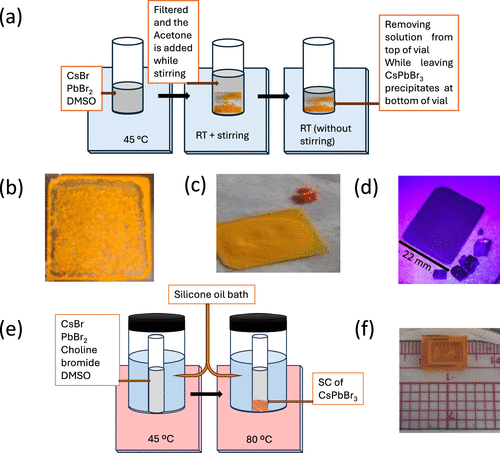
Illustration of steps in the researchers' study of the electrical behavior of CsPbBr3.
In their study, the researchers investigated how CsPbBr3 interacts with both visible and high-energy photons (particles that carry electromagnetic energy). They found that the material responds well to radiation, but also to visible and UV light, meaning it could be used as a wide-range light detector.
Their findings provide valuable insights for optimizing CsPbBr3-based devices for targeted applications in advanced sensing technologies.
This includes the monitoring of NPP structures and components for detecting stresses and leaks due to aging and degradation, safe storage of nuclear waste, and reliable long-term radiation monitoring.
“Traditional sensors that can detect radiation and monitor nuclear power plant structures and components for stresses and leaks require frequent calibrations, suffer from low tolerance in harsh environments, and only provide data at the discrete sensor locations,” Gartia said.
“Distributed Fiber Optic Sensing can overcome these limitations by providing rapid real-time measurement simultaneously along the entire fiber at high spatial resolution (a few centimeters) and with no additional electronics along the optical path.”
Read the paper: Khan, Tahira, et al. "Study of the Electrical Behavior of CsPbBr3 Single Crystal and Films under Visible and High-Energy Photons." ACS Applied Optical Materials 3.3 (2025): 620-629.
Next Step
Discover stories showcasing LSU’s academic excellence, innovation, culture, and impact across Louisiana.